Main Attractions
: Golden temple(Harmander
Sahib), Durgiana Temple (Lakshmi Narain Temple), Wagah Border,
Jallian Wala Bagh, Ram Tirath, Jama Masjid Khairuddin, Tarn Taran
KAPURTHALA
 Kapurthala, the
capital of the former Princely State of the same name, was in its
day, known as a city of Palaces, Mosques, Temples, Gurudwara and
gardens. The extent of the French influence in the architecture of
the main Palace, and some of the other buildings, its wide streets,
the Indo-Saracenic influence in the other prominent buildings and
the well co-ordinated aesthetic layout of most dwellings, being set
amidst a front of an acre of lawn and gardens, earned this small
Principality the sobriquet of the "Paris of the Punjab".
Kapurthala, the
capital of the former Princely State of the same name, was in its
day, known as a city of Palaces, Mosques, Temples, Gurudwara and
gardens. The extent of the French influence in the architecture of
the main Palace, and some of the other buildings, its wide streets,
the Indo-Saracenic influence in the other prominent buildings and
the well co-ordinated aesthetic layout of most dwellings, being set
amidst a front of an acre of lawn and gardens, earned this small
Principality the sobriquet of the "Paris of the Punjab".
Main Attractions
:
Sainik School (Jagatjit Palace),
Moorish Mosque, Jagatjit Club
PATIALA
 Patiala is a city in
the Punjab state of India. Patiala district is one of the famous
princely cities of erstwhile Punjab. Forming the south-eastern part
of the state, it lies
between 29°49’ and 30°47’ north latitude, 75°58’ and 76°54' east
longitude.
It is the administrative headquarters of Patiala District, and was
the capital of the
premier princely state in the former Punjab Province of British
India, headed by the Sidhu
dynasty. Patiala is famous for its peg (a reference to Patiala Peg),
pagri (traditional
headgear), paranda (tasselled tag for braiding hair and Jutti
(traditional Punjabi
footwear).
Patiala is a city in
the Punjab state of India. Patiala district is one of the famous
princely cities of erstwhile Punjab. Forming the south-eastern part
of the state, it lies
between 29°49’ and 30°47’ north latitude, 75°58’ and 76°54' east
longitude.
It is the administrative headquarters of Patiala District, and was
the capital of the
premier princely state in the former Punjab Province of British
India, headed by the Sidhu
dynasty. Patiala is famous for its peg (a reference to Patiala Peg),
pagri (traditional
headgear), paranda (tasselled tag for braiding hair and Jutti
(traditional Punjabi
footwear).
Main Attractions
: Qila Mubarak Complex, Qila
Androon, Sheesh Mahal, Moti Bagh Palace, Lachman Jhoola, Rajindera
Kothi, Baradari Gardens, Ijlas-e Khas, Gurudwara Dukhniwaran Sahib,
Kali Temple, Qila Bahadurgarh, Panj Bali Gurdwara
SIRHIND
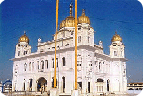 SIRHIND, a tract of
land in the Punjab, India. It consists of the north-eastern portion
of the plain between the Jumna and Sutlej rivers, and is watered by
the Sirhind canal. Sirhind is not an administrative division, but
historically the name includes the districts of Umballa, Ludhiana,
and Ferozepore, together with the states of Patiala, Jind and Nabha.
SIRHIND, a tract of
land in the Punjab, India. It consists of the north-eastern portion
of the plain between the Jumna and Sutlej rivers, and is watered by
the Sirhind canal. Sirhind is not an administrative division, but
historically the name includes the districts of Umballa, Ludhiana,
and Ferozepore, together with the states of Patiala, Jind and Nabha.
The Sirhind canal serves the Umballa and Ludhiana districts, and the
Patiala, Jind and Nabha states. It draws its water-supply from the
Sutlej near Rupar, where the head-works are situated. The canal,
which was opened in 1882, has 538 M. of main and branch canals, and
irrigates nearly 2000 sq. m. The town of Sirhind, in the state of
Patiala, had a population in 1901 of 5415. It is of very early, but
uncertain, foundation, and had a period of great prosperity under
the Moguls. Its ancient ruins cover a large extent, and include two
fine domed tombs of the 14th century. It is held accursed by the
Sikhs, owing to the barbarous murder of the son of Guru Govind by
the Mahommedan governor in 1704.
Main Attractions :
Aam Khas Bagh, Tomb of Mir-i-Mran, Rauza Sharif Of Sheikh Ahmed
Farooqi, Mujadid Alif-Saani, Fatehgarh Sahib
KURUKSHETRA
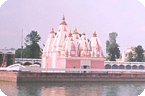 Kurukshetra is the
name of a city in the present-day Indian state of Haryana. The name
literally means "Land of the Kaurava" after the Kuru clan. It is
supposed to be the site of the Kurukshetra war, described in the the
Mahabharata. It is of great importance in Hinduism as this is where
the Bhagavad Gita was taught to Arjuna on the battle field, just
before the great battle.
Kurukshetra is the
name of a city in the present-day Indian state of Haryana. The name
literally means "Land of the Kaurava" after the Kuru clan. It is
supposed to be the site of the Kurukshetra war, described in the the
Mahabharata. It is of great importance in Hinduism as this is where
the Bhagavad Gita was taught to Arjuna on the battle field, just
before the great battle.
Thanesar or Sthaneswar, a historical town is located adjacent to
what is now newly created Kurukshetra city. Local hearsay identifies
the legendary "Kurukshetra" with a nearby obscure hamlet, and with
the active abetment of the state government, it is presently
experiencing a tourist boom.
Main Attractions :
Brahma Sarovar, Jyotisar,
Krishna Museum, Sheikh-Chilli ka makbara (tomb), Kamal Nabhi,
Bhadrakali Mandir, Birla Mandir, Chhati Path Shahi Gurudwara
PINJORE
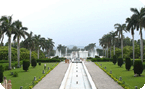 Pinjore is an
ancient historical and religious place. It is said to he the
earliest
Pinjore is an
ancient historical and religious place. It is said to he the
earliest
habitation of man and it is said that the early man lived in Pinjore
region round about Chandigarh, one and half crores years ago.
Pinjore Gardens, also called Yadavindra Gardens are 20 km from
Chandigarh, 15 km from Panchkula, on the Chandigarh Shimla road.
Taxis and buses ply regularly between Pinjore, Kalka, Panchkula and
Chandigarh. Pinjore
lies on the foothills of the lower Shivalik ranges. The fascinating
Mughal Gardens one of the most popular picnic spots. A mini zoo,
plants nursery, a Japanese garden, historic palaces and picnic lawns
await tourists. Especially at weekends, fountains are switched on
and after dusk, lights pick up the beauty of the palaces by night.
SHIMLA
 Shimla (also known as
Simla) is a tourist destination par excellence. It is a beautiful
hill town in the lap of nature, surrounded by pine and deodar
forests. Temperature is ideal in summers and tourists flock it in
great numbers and it is highly advisable to get hotel reservations
done well in advance despite the fact that there are over 1000
hotels in Shimla. It is well connected by road to the plains.
Facilities and amenities are good. People are friendly. It is also
comparatively safer than other tourist destinations. All this makes
it the favorite travel destination of tourists from India and across
the world. A amazingly high percentage of tourists come back here
again.
Shimla (also known as
Simla) is a tourist destination par excellence. It is a beautiful
hill town in the lap of nature, surrounded by pine and deodar
forests. Temperature is ideal in summers and tourists flock it in
great numbers and it is highly advisable to get hotel reservations
done well in advance despite the fact that there are over 1000
hotels in Shimla. It is well connected by road to the plains.
Facilities and amenities are good. People are friendly. It is also
comparatively safer than other tourist destinations. All this makes
it the favorite travel destination of tourists from India and across
the world. A amazingly high percentage of tourists come back here
again.
It is situated in the north-west Himalayas and is the capital of the
state of Himachal Pradesh in North India. It is a 18 sq km
mountainous region lying at an altitude of 2,213 meters. British
coined the term “Queen of the hills” for Shimla. It has been blessed
with all the natural bounties, one can think of.
Main Attractions :
The Ridge, Lakkar Bazaar, Jakhu Hanuman
Temple, St. Micheal's Cathedral, Bhargaon, The Glen, Chadwick Falls,
Mashobra, KUFRI MINI ZOO, State Museum
PALAMPUR
 Palampur also known as
the 'Tea Capital of North India', is a popular hill station because
it is not only known for its scenic beauty but also for the
beautiful temples and buildings built in the Colonial period. Here a
nature lover can enjoy a quiet stroll while feasting his eyes on the
natural beauty and an outdoor lover with a taste for adventure can
enjoy hand gliding and trekking during the holiday. It has something
for all tastes, which makes it an ideal holiday resort for many.
Palampur also known as
the 'Tea Capital of North India', is a popular hill station because
it is not only known for its scenic beauty but also for the
beautiful temples and buildings built in the Colonial period. Here a
nature lover can enjoy a quiet stroll while feasting his eyes on the
natural beauty and an outdoor lover with a taste for adventure can
enjoy hand gliding and trekking during the holiday. It has something
for all tastes, which makes it an ideal holiday resort for many.
Main Attractions :
Bir and Billing, Baijnath , Neugal Khad,
Bundla Stream, Andretta, Chamunda Devi, Sujanpur Tira
TARAGARH
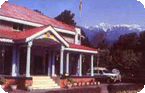 Built by the Nawab of
Bhawalpur in 1937, the Taragarh Palace is located in the midst of 15
Built by the Nawab of
Bhawalpur in 1937, the Taragarh Palace is located in the midst of 15
acres of forest and tea gardens in the Kangra Valley in Himachal
Pradesh. The palace is situated at an altitude of 1000 m and offers
a panoramic view of the snow-clad ranges of the Dhauladhar
Mountains, which forms the backdrop of the palace.
PRAGPUR
 Pragpur, the first
heritage village in the Kangra Valley with panoramic view is replete
with myth and folk lore about the times when the Pandavas in exile
roamed this land. Pragpur is a small hamlet with very little
population. It is located at an elevation of 1800 ft above the sea
level in the Kangra Valley. Pragpur village lies on the foothills of
the massive Dhauladhars popularly referred to as the White Ranges.
Pragpur, the first
heritage village in the Kangra Valley with panoramic view is replete
with myth and folk lore about the times when the Pandavas in exile
roamed this land. Pragpur is a small hamlet with very little
population. It is located at an elevation of 1800 ft above the sea
level in the Kangra Valley. Pragpur village lies on the foothills of
the massive Dhauladhars popularly referred to as the White Ranges.
Main Attractions
: The Taal, Bhutail Niwas,
Nakki
DHARAMSHALA
(MCLEOD GANJ)
 Dharamsala, popularly
known as the ‘Queen of the Hills’, is divided into lower and upper
towns with a difference of 457m(1500ft.) between them. The mountains
enfold 3 sides of the
town and the valley stretches to the south. There is a beautiful
resort of Dharamsala, which stands on the spur of the Dharamsala
range. Dharamshala stands at the foot of Dhauladhar and has a
magnificent view of snowy peaks, deodar and pine forests, tea
gardens and beautiful hills. The snow line is perhaps more easily
accessible at Dharamshala than any other hill station in India.
Dharamsala, popularly
known as the ‘Queen of the Hills’, is divided into lower and upper
towns with a difference of 457m(1500ft.) between them. The mountains
enfold 3 sides of the
town and the valley stretches to the south. There is a beautiful
resort of Dharamsala, which stands on the spur of the Dharamsala
range. Dharamshala stands at the foot of Dhauladhar and has a
magnificent view of snowy peaks, deodar and pine forests, tea
gardens and beautiful hills. The snow line is perhaps more easily
accessible at Dharamshala than any other hill station in India.
Main Attractions
: Mcleod Ganj, Bhagsunag
Fall, St. John's Church, Dharamkot, War Memorial, Triund, Kunal
Pathari, Kareri, Dal Lake
KULLU MANALI
 Kullu was once known
as "Kulanthpitha", which means the end of the habitable
Kullu was once known
as "Kulanthpitha", which means the end of the habitable
world. Beyond rose the forbidding heights of the Greater Himalayas,
and by the banks of the shining river Beas, lay the fabled 'Silver
Valley' of Kulu. Here is the core of an intricate web of numerous
valleys - each of which is a visual delight and seems more beautiful
than the other. The Himalayan mountain scapes remain spectacular
whether in brilliant sunshine or in the haze of the mist.
40 kms. away from Kulu to the north, Manali is situated near the end
of the valley on the National Highway leading to Leh. The landscape
here is breath taking. One sees well-defined snow capped peaks, the
Beas river with its clear water meanders through the town. On the
other side are deodar and pine trees, tiny fields and fruit
orchards. It is an excellent place for a holiday, a favorite resort
for trekkers to Lahaul, Spiti, Kinnaur, Leh and Zanskar regions in
Kashmir valley. It is known as the SWITZERLAND OF INDIA.
Main Attractions :
Raghunathji Temple, Vaishno Devi
Temple, Sultanpur Palace, Parvati Valley & Manikarna, Hadimba
Temple, Vashist Springs, Rohtang Pass, Arjun Gufa
CHAMBA VALLEY
 Chamba, the land of
antiquity, art and scenic beauty, is a wonder in itself for every
visitor. Situated at the height of 996 m. above sea level on the
south bank of the Ravi River, the ancient Pahari capital was founded
in 920 A.D. by Raja Sahil Verma, who named it after his favourite
daughter Champavati.Chamba valley is noted for the magnificence of
it's scenery-touching the fringe of the Shivaliks and having three
well-defined snowy ranges, the Dauladhar, constituting the outer
Himalayas, the Pir Panjal or the mid Himalayas, and the Zanskar
range or the inner Himalayas.
Chamba, the land of
antiquity, art and scenic beauty, is a wonder in itself for every
visitor. Situated at the height of 996 m. above sea level on the
south bank of the Ravi River, the ancient Pahari capital was founded
in 920 A.D. by Raja Sahil Verma, who named it after his favourite
daughter Champavati.Chamba valley is noted for the magnificence of
it's scenery-touching the fringe of the Shivaliks and having three
well-defined snowy ranges, the Dauladhar, constituting the outer
Himalayas, the Pir Panjal or the mid Himalayas, and the Zanskar
range or the inner Himalayas.
Main Attractions
: Bhuri Singh Museum,
Champawati Temple, Chaurashi Temple, Lakshmi Narayan Temple, Lama
Dal, Markula Devi Temple, Pangi Valley, Parbati Valley, Rang Mahal,
Chamera Lake, Ghadhasaru Lake, Maharaja's Palace, The Chamba Rumal
LADAKH
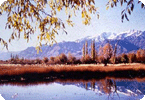 Ladakh is a land
abounding in awesome physical features, set in an enormous and
spectacular environment. Bounded by two of the world's mightiest
mountain ranges, the Karakoram in the north and the Great Himalaya
in the south, it is traversed by two other parallel chains, the
Ladakh Range and the Zanskar Range. Dras, Zanskar and the Suru
Valley on the Himalaya's northern flanks receive heavy snow in
winter, this feeds the glaciers from which melt water, carried down
by streams, irrigates the fields in summer. For the rest of the
region, the snow on the peaks is virtually the only source of water.
Ladakh is a land
abounding in awesome physical features, set in an enormous and
spectacular environment. Bounded by two of the world's mightiest
mountain ranges, the Karakoram in the north and the Great Himalaya
in the south, it is traversed by two other parallel chains, the
Ladakh Range and the Zanskar Range. Dras, Zanskar and the Suru
Valley on the Himalaya's northern flanks receive heavy snow in
winter, this feeds the glaciers from which melt water, carried down
by streams, irrigates the fields in summer. For the rest of the
region, the snow on the peaks is virtually the only source of water.
Main
Attractions :
Leh, Dha-Hanu, Central Ladakh, Nubra Valley, Changthang Area,
Zanskar, Suru Valley, Pangong Tso
CHANDIGARH
 The city of Chandigarh
is situated at the base of the Shiwalik Range of the Himalayas, at
333m above sea level, approximately 260 km northwest of India's
capital, New Delhi. The site is a gently sloping plain, with two
seasonal rivulets - Patiali-ki-Rao and Sukhna Choe -marking its
northwest and southeast boundaries. The city forms the urban core of
the "Union Territory of Chandigarh", which has a total area of 114
sq km. All of the urban and architectural work of Le Corbusier
listed in this document is located within Chandigarh's "Phase One",
an area of approximately 70 sq. km. which can be regarded as the
city's "Historic Core."
The city of Chandigarh
is situated at the base of the Shiwalik Range of the Himalayas, at
333m above sea level, approximately 260 km northwest of India's
capital, New Delhi. The site is a gently sloping plain, with two
seasonal rivulets - Patiali-ki-Rao and Sukhna Choe -marking its
northwest and southeast boundaries. The city forms the urban core of
the "Union Territory of Chandigarh", which has a total area of 114
sq km. All of the urban and architectural work of Le Corbusier
listed in this document is located within Chandigarh's "Phase One",
an area of approximately 70 sq. km. which can be regarded as the
city's "Historic Core."
Main
Attractions : Sukhna
Lake, Rock Garden,
The Museum and Art Gallery, The
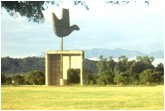
Open Hand Monument,
Rose Garden, Mansa Devi
RISHIKESH
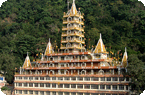 Rishikesh represents the Gateway to
the Himalayas in the Tehri-Garhwal region of Uttar Pradesh.
Rishikesh has a number of tourist places that one can visit. Since
Rishikesh is known as a pilgrimage center, religious places form a
major chunk of tourist attractions in Rishikesh.Triveni Ghat is a
popular place in Rishikesh. Many people take a dip at the ghat
before visiting temples in Rishikesh. Rishikesh is an exciting
destination that is dotted with a number of temples and ashrams.
Rishikesh is surrounded by the verdant forest and river Ganges flow
through the town.
Rishikesh represents the Gateway to
the Himalayas in the Tehri-Garhwal region of Uttar Pradesh.
Rishikesh has a number of tourist places that one can visit. Since
Rishikesh is known as a pilgrimage center, religious places form a
major chunk of tourist attractions in Rishikesh.Triveni Ghat is a
popular place in Rishikesh. Many people take a dip at the ghat
before visiting temples in Rishikesh. Rishikesh is an exciting
destination that is dotted with a number of temples and ashrams.
Rishikesh is surrounded by the verdant forest and river Ganges flow
through the town.
Main Attractions
: Laxman Jhula, Swarg Ashram,
Gita Bhavan, Ram Jhula, Triveni Ghat, Shivanand Jhoola, Neelkanth
Mahadev, Bharat Temple, Devprayag, Kunjapuri
HARIDWAR
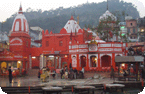 Haridwar located in
the foothills of the Himalayas, represents the point where the Ganga
reaches the plains. Haridwar is an ancient pilgrimage site, held in
reverence for centuries. The Chinese pilgrim Hyuen Tsang who visited
India in the first millennium CE, describes Haridwar as Mayura, on
the eastern banks of the Ganges. Several temples and ashrams dot
this town and a visit to Haridwar is like stepping into a totally
different world.
Haridwar located in
the foothills of the Himalayas, represents the point where the Ganga
reaches the plains. Haridwar is an ancient pilgrimage site, held in
reverence for centuries. The Chinese pilgrim Hyuen Tsang who visited
India in the first millennium CE, describes Haridwar as Mayura, on
the eastern banks of the Ganges. Several temples and ashrams dot
this town and a visit to Haridwar is like stepping into a totally
different world.
Main Attractions :
Chandi Devi, Bharat Mata Temple, Shanti Kunj, Maya
Devi Temple, Har-Ki-Pauri
MUSSOORIE
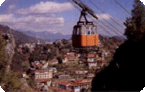 Mussoorie is an
excellent respite for tourists and people who want relief from the
hot sultry conditions of the plains. Nature has gifted Musoorie
everything which makes a place beautiful. 38 Kms from Dehradun is
Mussoorie with its green hills and varied flora and fauna, is a
fascinating hill station. It offers a wonderful view of the
Himalayan snow ranges to the north-east and the Doon Valley.,
Roorkee, Saharanpur and Haridwar to the South, creating an almost
serene atmosphere for the tourists.
Mussoorie is an
excellent respite for tourists and people who want relief from the
hot sultry conditions of the plains. Nature has gifted Musoorie
everything which makes a place beautiful. 38 Kms from Dehradun is
Mussoorie with its green hills and varied flora and fauna, is a
fascinating hill station. It offers a wonderful view of the
Himalayan snow ranges to the north-east and the Doon Valley.,
Roorkee, Saharanpur and Haridwar to the South, creating an almost
serene atmosphere for the tourists.
Main Attractions
: Lal Tibba, Gun Hill, Nag Tibba,
Yamuna Bridge, Bhadraj Temple Mussoorie Lake, Kempty Fall





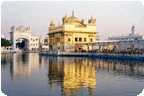 The word Amritsar means the holy pool
of nectar. 573 Work began on digging the holy pool. 1601 Harmandir
Sahib completed. 1604 Guru Granth Sahib installed. Alongside people
representing 52 professions settled. In Maharaja Ranjit Singh's time
Amritsar had superceded Lahore as the pre-eminent city of the
Orient.
Amritsar is one of the most ancient and fascinating cities
of India. It is an important
seat of Sikh history and culture. Being
the gateway for travellers coming to India on the overland route
from central Asia it soon became the centre of various commercial
activities.
The word Amritsar means the holy pool
of nectar. 573 Work began on digging the holy pool. 1601 Harmandir
Sahib completed. 1604 Guru Granth Sahib installed. Alongside people
representing 52 professions settled. In Maharaja Ranjit Singh's time
Amritsar had superceded Lahore as the pre-eminent city of the
Orient.
Amritsar is one of the most ancient and fascinating cities
of India. It is an important
seat of Sikh history and culture. Being
the gateway for travellers coming to India on the overland route
from central Asia it soon became the centre of various commercial
activities.